


HonorHealth cut average length of stay from 5.41 to 4.74 days after moving to asynchronous rounds. Here’s how the model works, from a Becker’s Healthcare webinar with HonorHealth and Qventus.
The discharge call is on Teams. A hospitalist moves through patients at 20 to 30 seconds each. A case manager, clearing their inbox between updates, hears their patient’s name a beat too late. By the time they’re off mute, the call has moved on.
For HonorHealth, that moment captured why its discharge rounds had stopped working, and it led the system to asynchronous rounds.
The gap between a plan and a shared plan
HonorHealth runs hospitals across the Phoenix area, ranging from about 70 to 450 beds. Before 2021, its multidisciplinary rounds weren’t standardized or focused on discharge. Physicians didn’t attend, and nobody entered expected discharge dates or dispositions in Epic.
Discharge planning happened in hallway conversations. One person might know the plan, while the rest of the care team, and the family, didn’t.
That gap is common. When webinar attendees were asked what most often derails expected discharge dates, 44% said care teams aren’t aligned on the plan.
Why traditional discharge rounds fall short
HonorHealth got physicians to rounds by promising each one a 10-minute block. That meant nurses, therapists and case managers spent about two-thirds of every hour waiting for the patients on their unit to come up.
Moving rounds online let people multitask, but attention dropped with it. As patient volumes rose, the conversation turned into one-way data sharing. Gains in length of stay plateaued and frustration grew. Eventually the system’s largest hospital asked for a different model.
How asynchronous rounds work
The change is simple. Hospitalists complete the QCard, a Qventus side panel in Epic, before rounds start. They confirm the expected discharge date (EDD), the disposition, whether discharge will be AM or PM, and any barriers.
Much of the card is already filled in. The Qventus Inpatient Capacity Solution predicts the EDD and disposition by the first morning after admission, and it automates 85 to 90% of discharge milestones, such as whether the MRI or the neuro consult is done.
Nurses, supervisors, therapy and case management then round on each unit at the same time, with the physician’s plan in front of them. Bedside nurses can now join, so the discharge plan reaches the person caring for the patient. If a patient improves later in the day, the team messages the provider and updates the QCard.
The biggest fear was losing the physician’s voice. Harold Peters, Executive Consultant at HonorHealth, said the data showed the loss was “more than offset by the gain in efficiency.” Liza Rubio put it more simply: the result is “just more conversation.”
The operational results
- Average length of stay fell from 5.41 days to 4.74 over 12 months.
- Length of stay dropped 0.40 days comparing the periods before and after asynchronous rounds.
- Rounds shortened from an hour to 30 to 35 minutes.
- HonorHealth ranks in the top decile for length of stay among Epic customers, and the top 25% for excess days.
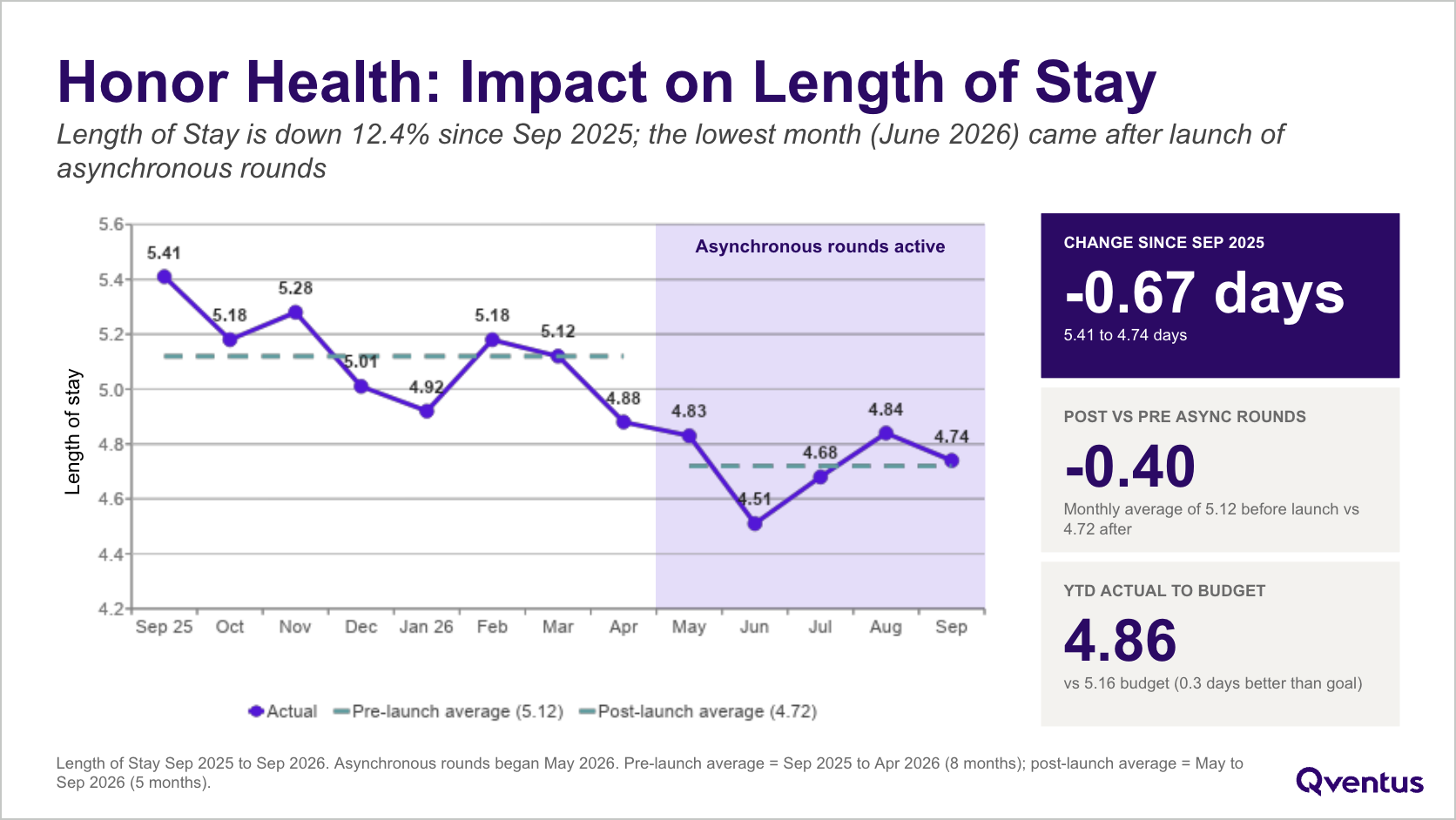
The length-of-stay trend didn’t flatten after go-live. It kept falling at the same rate.
Across health systems, Qventus reports a 15 to 30% reduction in excess days, or roughly 25 beds of added capacity at an average 500-bed hospital. For the full picture of HonorHealth’s results, read the HonorHealth customer success story.
What made it stick
HonorHealth found that technology creates visibility, but behavior changes only with clear goals. Teams know the two targets: discharge before noon, and discharge within two hours of the order. Network-level throughput committees share what’s working from one campus to the next.
Two lessons stand out. First, keep rounding on every patient. “No change” takes seconds, and it catches updates one person missed. Second, fit the model to the hospital. Smaller hospitals of about 70 beds still run synchronous rounds well. Nearly all of HonorHealth’s large hospitals have switched to asynchronous rounds.
The bottom line
Asynchronous rounds keep physicians in discharge planning; they just put physician input ahead of the meeting. The result is shorter rounds, more engaged teams and a length-of-stay curve that kept falling.
This post is based on a Becker’s Healthcare webinar featuring Harold Peters, Liza Rubio and Anthony Martinez of HonorHealth, and Dr. Jason Cohen, Chief Medical Officer, Inpatient, at Qventus. Watch the full webinar to hear the team’s answers to audience questions on QCard documentation, late-day discharges and patient education.