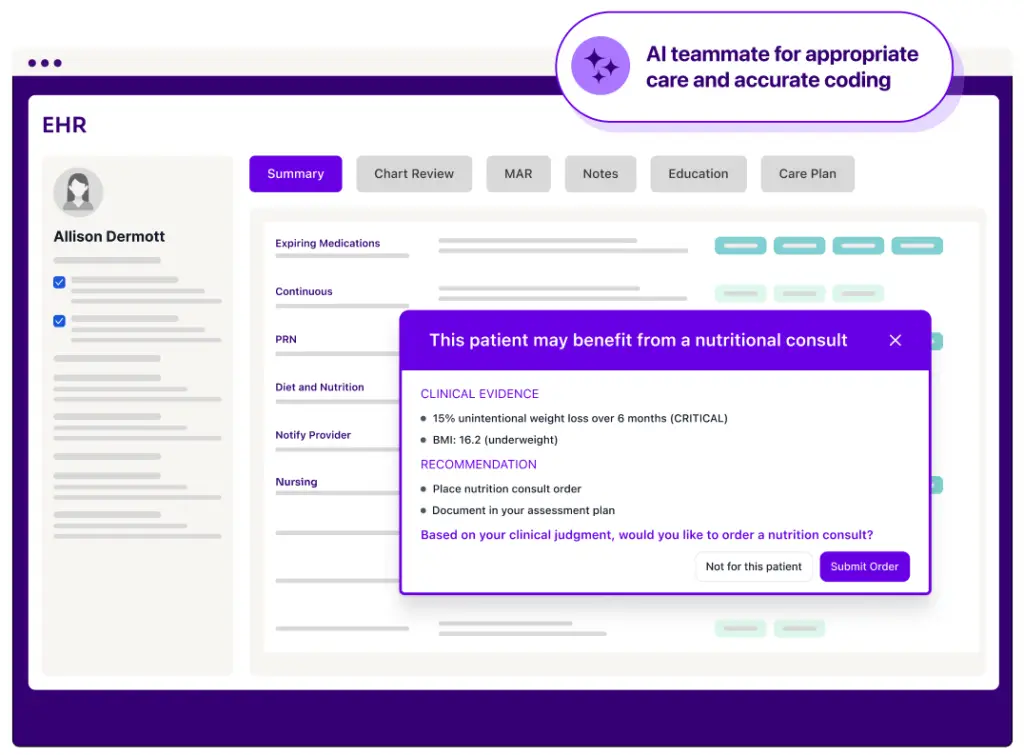
Prior to working with Qventus, malnutrition code capture averaged approximately 9% across the Health System’s two pilot facilities. Despite significant investments in clinical documentation improvement (CDI) and an established screening process led by dietitians on the units, opportunities to identify malnutrition were still being missed.
With an estimated 20–30% of hospitalized patients experiencing malnutrition, the Health System recognized that relying primarily on traditional screening measures, such as MST scores and BMI, was insufficient.
The Health System deployed Malnutrition Care Automation, part of Qventus’ broader Care Gap & Coding Automation solution. The solution analyzes structured and unstructured EHR data against ASPEN guidelines, including weight trends, fluid accumulation, and muscle mass loss, to identify patients at risk of malnutrition who may otherwise be missed by traditional screening.
Each morning, dietitians view a list of at-risk patients, prioritized by risk level and supported by the clinical evidence behind each flag. Dietitians then complete their standard nutrition assessment directly in the EHR, keeping the existing clinical workflow intact.
Condition Detection Assistant: Ingests real-time structured and unstructured chart data to identify patients at risk for malnutrition early in their inpatient stay.
Care Gap Assistant: Pre-populates an order for a nutrition consult and prompts the provider within their workflow to sign off. Surfaces intelligence into the dietitian’s worklist to prioritize and streamline assessments.
Coding and Documentation Assistant: Ensures appropriate capture of clinical complexity in documentation to support accurate MCC/CC capture.
Impact Assistant: Qventus analytics provide visibility into provider response rate, condition capture lift, revenue gains, and detailed evidence to support audits, reduce denials, and streamline eCQM Malnutrition Care Score reporting.
Simplifying surgical scheduling: Qventus’ digital booking interface, TimeFinder, enables schedulers to easily find open time slots. The software determines the best-fit slots for any given case—factoring in things like day of week, time, the type of room and any special equipment needed, duration of procedure, and more—and offers a list of available slots that most closely fit the criteria. The clinic scheduler can book the time and submit the case request information with just a few clicks.
Improving block time utilization: Machine learning algorithms learn from a surgeon’s historical practice patterns and use that data to predict, up to a month in advance, time within each surgeon’s block that is unlikely to be used. When the system identifies a slot with a significantly high probability of going unused, it sends an automated “nudge” to the surgeon’s scheduler, requesting a release of the slot. To incentivize the release, the nudge includes a calculation of how much the release will improve the surgeon’s block utilization rate.
Proactively filling unused slots: Under a manual process, unused slots are often filled with the first available procedure, rather than the most appropriate one. The Qventus Perioperative Solution’s Available Time Outreach functionality analyzes the characteristics of available slots, matches them with surgeons’ predicted needs, then offers the best-fit slots via email to the surgeon who’s most likely to use it and who also represents the highest value to Banner Health. The scheduler can accept or decline with a few clicks. If they decline, the system automatically moves to the next most likely candidate.
Ut blandit pulvinar volutpat. Cras egestas sem turpis, non accumsan justo cursus viverra. Proin ipsum arcu, dignissim a enim eu, tristique eleifend orci. Etiam commodo dignissim nisi, sed finibus metus auctor in. Nulla venenatis porttitor risus non pretium. In rhoncus tempor mauris. Orci varius natoque penatibus et magnis dis parturient montes, nascetur ridiculus mus.