

A patient gets a text message. Not from a stranger, not a chatbot pretending to be human, but Aubrey, clearly labeled as Novant Health’s AI assistant. Stop eating by midnight, your procedure is at 7am, here’s where to park.
That small interaction is the visible part of a much bigger shift happening inside health systems right now.
Novant Health launched Aubrey this month, an AI-enabled virtual assistant built with Qventus to support patients through perioperative care.
Why surgery first
Surgery is one of the highest-stress, highest-stakes moments in a patient’s care journey, and one of the most operationally fragile. A missed pre-op instruction or unconfirmed fasting window can lead to a canceled procedure and a frustrated patient who waited weeks for their slot.
Sanjay Gupta, Novant Health’s Executive Vice President and Chief Transformation Officer, framed the decision around timing: starting with surgical care lets the system focus on a moment when clarity matters most, when patients already have enough on their mind.
What patients actually experience
Once a procedure is scheduled, Aubrey reaches out by text. Patients can chat back with questions. Aubrey can:
- Send reminders about preoperative fasting and medication instructions
- Explain what to expect before and after the procedure
- Help coordinate scheduling with the pre-op team
- Share parking information and day-of-surgery tips
- Flag early concerns so care teams can follow up
None of this replaces a patient’s care team. Aubrey runs human-in-the-loop, in a HIPAA-compliant environment, and is not built for emergencies.
What’s powering Aubrey
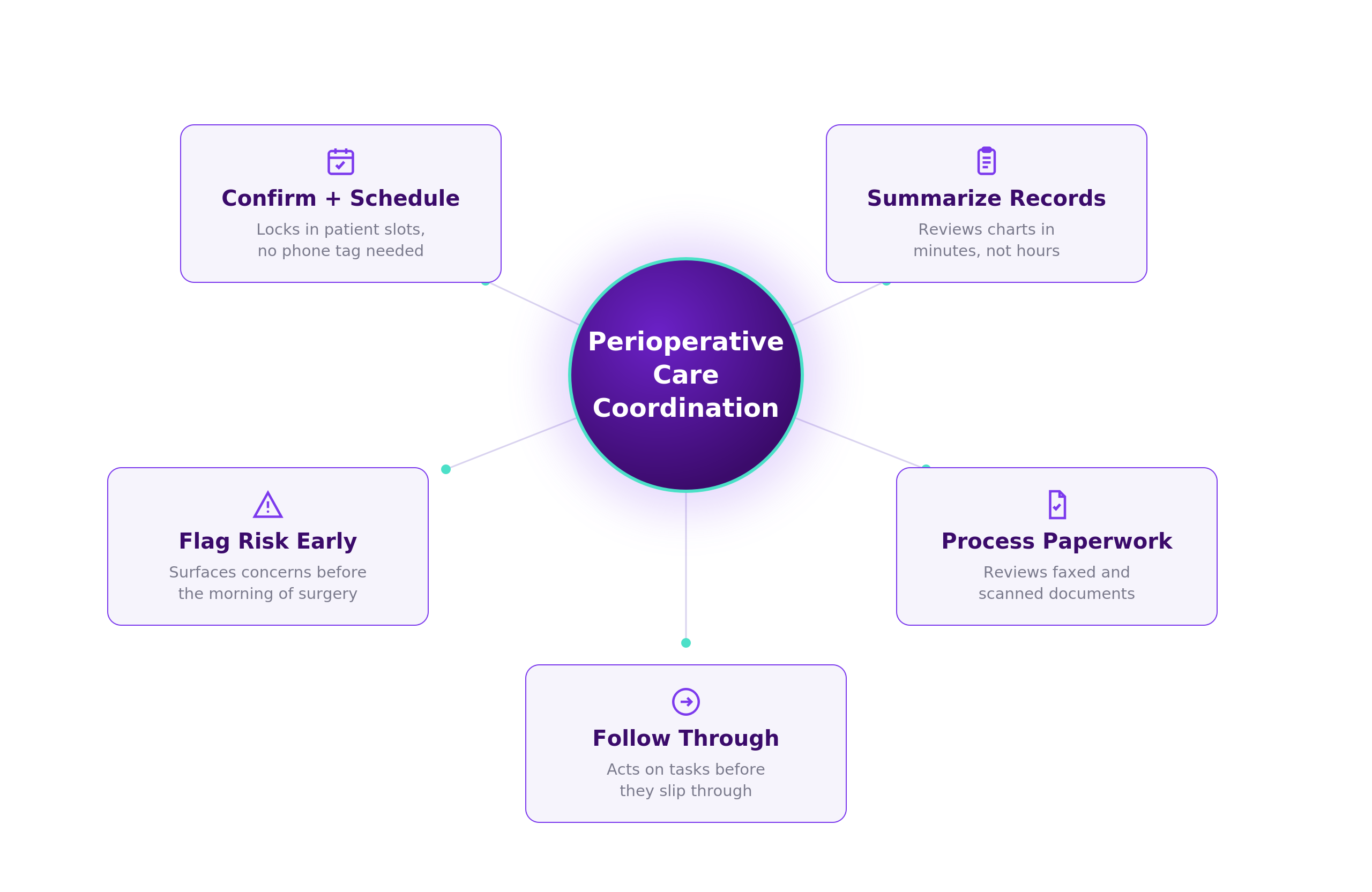
What makes Aubrey possible is a set of AI agents built into Qventus’s Perioperative Care Coordination Solution, each handling a piece of work that used to fall entirely on PAT staff:
- Confirm and schedule. Agents confirm patient availability and coordinate pre-op appointments, so nurses aren’t stuck chasing down timing over the phone.
- Pull and summarize records. Agents track down medical records and chart history, then summarize them so a nurse can review a patient’s history in minutes, not by paging through a chart.
- Flag risk in real time. Using EHR data, chart review, and patient conversations, agents flag risk factors early, the kind that might otherwise surface for the first time the morning of surgery.
- Process paperwork at scale. Faxed, scanned, and emailed documents get reviewed and assessed automatically instead of sitting in a queue.
- Follow through. When something needs action, an agent takes it, rather than leaving a follow-up item to fall through the cracks.
The pattern is the same throughout: agents that don’t just surface information, but act on it.
Why It Matters, and What Comes Next
More than half of provider time goes to below-license administrative work. Most of that load is invisible to patients, but it’s exactly where cancellations get created: a delayed records request, a missed risk flag, an unconfirmed fasting instruction. Each is small alone. Together, they add up to a meaningful share of avoidable same day surgery cancellations.
Health systems ready to reduce surgical cancellations, lighten the load on PAT staff, and give patients a better experience before they ever walk through the door are already looking at what Novant Health built. The infrastructure that makes Aubrey possible is available today.
Explore the Perioperative Care Coordination Solution or Support Patients and Reduce Same-Day Cancellations
Source: Novant Health press release and Aubrey patient resource pages, June 2026.